
Bailey's Crossroads Resident Lookup Records
There is no master person file for a Bailey's Crossroads resident lookup. Bailey's Crossroads sits inside Fairfax County. County and state custodians hold the useful records, and each one answers a different question. The county's iCare property search ties a street address or parcel to an owner-of-record display. It also shows tax mailing details where shown, assessment data, and deed references. That is real context. It still does not tell you who occupies the site. Court indexes show case parties. Election rolls show registered voters. Vital records date family events, and the state licenses professionals. The strongest way to look up a resident in Bailey's Crossroads is to keep each fact next to its source. Note its limitation too. A residents directory built from one record alone is a guess.
| Record | What It Confirms | Where | Access |
|---|---|---|---|
| Parcel and assessment profile | Parcel identity, owner or mailing display, tax year, and deed references | Fairfax iCare and MAR | Online, county terminals, or DTA |
| Court case index | Named case party, case number, case type, and filed or final-order date when shown | Fairfax GDC, CPAN, or Circuit Clerk | Online route, clerk counter, phone, or defined copy request |
| Voter service record | Authorized voter-status or precinct information | Virginia Citizen Portal and Fairfax Elections | Authorized portal use or approved list request |
| Vital certificate or index | Eligible family-event information and identity details | Virginia Department of Health or archives | Age and relationship rules, mail, online, or counter |
| Historical directory material | Dated name and address association | Virginia Room, HRC, or Library of Virginia | Library databases, microfilm, archive, or reference request |
Match the tool to the question. A current Bailey's Crossroads address question starts with MAR or iCare, and the result gets labeled as an address, parcel, owner, or mailing record. A dated household question points instead to the Virginia Room, a yearbook, a newspaper archive, or a street directory of the era. A case number belongs with the clerk. A family event belongs with VDH or a historical archive. A Bailey's Crossroads resident lookup earns confidence only when two independent records, pointing to the same person and the same years, agree.
Verify a Bailey's Crossroads Resident
Verify one narrow thing at a time. The same name can appear in a county parcel, a court index, and an old city directory without being the same person. Bailey's Crossroads adds its own wrinkles. A record may carry a Falls Church mailing city, a Fairfax County jurisdiction, and one of several nearby ZIP codes. Before comparing names, write down the full address, any unit, and the date. Add the source office and the role the record shows. That habit builds a citation trail. It does not build an all-purpose profile, and it should not try to.
- Search MAR or iCare with the known address or parcel detail. Capture the address, unit, ZIP, jurisdiction, parcel PIN, and date-status fields that appear.
- Label the property result correctly. An owner of record, tax mailing recipient, deed grantee, and occupant are separate roles in a Bailey's Crossroads resident lookup.
- Search the relevant court route by the most precise name variation and, when known, case number or hearing date. Save the case number and case type instead of treating a name hit as identity proof.
- Use an authorized voter route or a public-age vital record only for the limited fact it can support. Compare dates and geography with the first source.
- Confirm a material fact with the custodian. Cite the office, search date, record type, date range, and the narrow fact actually visible.
Older Bailey's Crossroads research often starts at the Fairfax County Public Library Virginia Room, with its local-history databases, newspapers, directories, yearbooks, microform services, and CPAN access. The Virginia Room gives historical context, not the official case file or certificate. For an address-name trail across past residents of Bailey's Crossroads, the Bailey's Crossroads city directory collections offer the separate historical street-directory route.
- Docket
- A court's running record of a case, used to identify the case number, parties, filings, and actions.
- Index and image
- An index points to a record. An image is the document itself and may have separate access, fees, or redactions.
- Certified copy
- A copy issued by the record custodian with certification for a purpose that requires an official copy.
Note: A matching Bailey's Crossroads address and date identifies a person far better than a shared surname, especially where mailing-city labels and county jurisdiction diverge.
Bailey's Crossroads Court Lookup Route
The Virginia case-information hub routes searches to court-specific systems. Pick Fairfax General District Court in the statewide GDC interface. Its controls cover court selection, plaintiff or defendant name, case number, and hearing date. Fairfax Circuit Court, though, does not join the statewide circuit search. So a blank statewide circuit result says nothing about a Bailey's Crossroads case. For a Circuit matter, go through the local clerk. CPAN works where the category qualifies. The courthouse public terminal is another route. A written request is one more. Name the court, the case number, and the document you want. A defined request reaches the right file far more often than a broad name search.
| GDC search field | Use in a Bailey's Crossroads check | Limit |
|---|---|---|
| Court selection | Choose Fairfax General District Court before searching. | Required for the court-specific search. |
| Plaintiff or defendant name | Try exact spelling and a supported name variation. | A party name alone does not establish identity or residence. |
| Case number | Use when known to narrow the result. | It identifies a case, not a whole personal history. |
| Hearing date | Use the date-search mode for a known proceeding. | Availability and detail are court specific. |
A Virginia court search screen appears below. Fairfax GDC matters follow the selected-court route, while Fairfax Circuit file and image access stays with the local clerk.
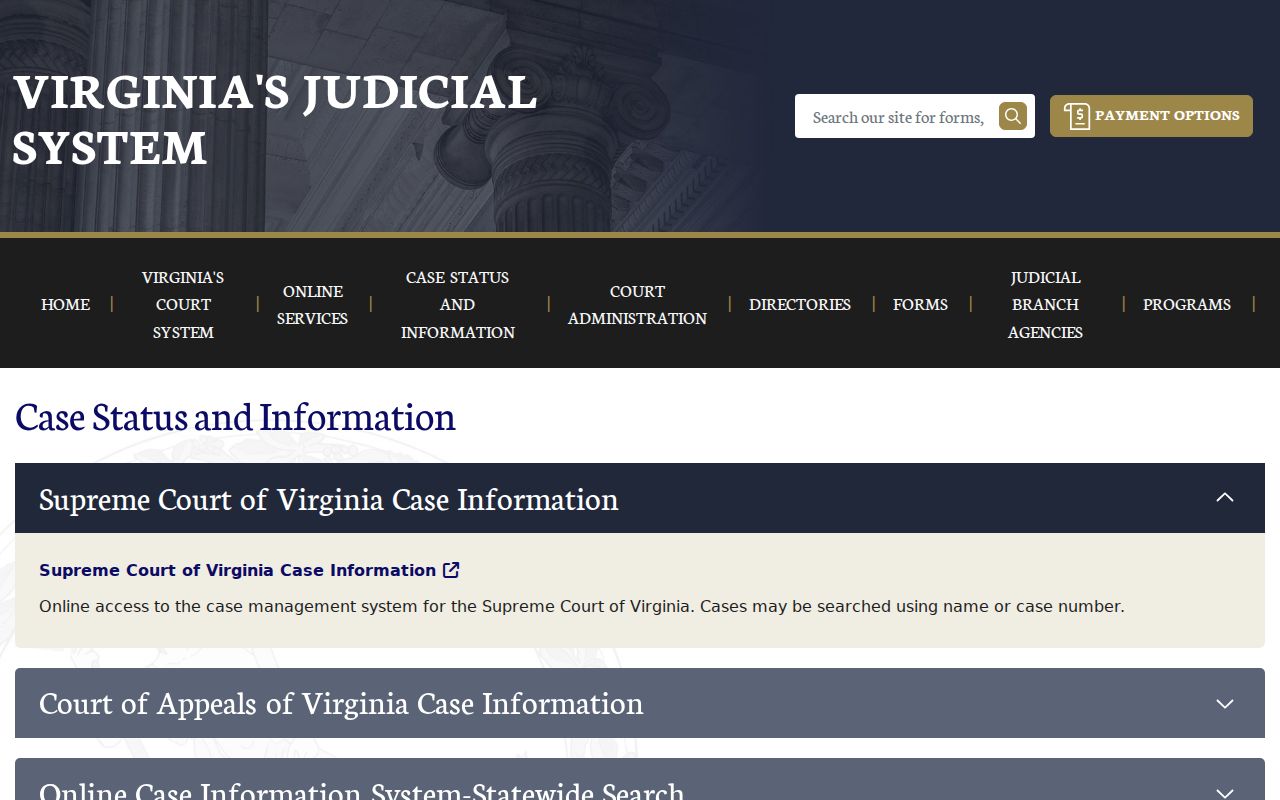
Use that screen to select the proper court first. Then preserve the case number and source date. Ask the clerk about a specific Bailey's Crossroads court file after that.
Fairfax GDC sits at 4110 Chain Bridge Road, reachable at 703-246-3764. The Fairfax Circuit statewide-search referral line is 703-246-4111. For a Bailey's Crossroads court request, ask by court, case number, document, and filing date. The narrower the request, the sooner it lands on the right record.
Bailey's Crossroads Court Result Fields
The official VJEFS interface model shows what a court search can return. Result columns include Case Number, Party Name, Case Style, Case Type, Date Filed, Date of Final Order, and Action. The Action control opens the available case-detail steps. The manual does not promise that every Fairfax matter carries every field online. It also says nothing about image availability. Treat any Bailey's Crossroads result as a locator. The authoritative file lives with the local clerk. A court index alone is never a complete resident record.
- Party Name and Case Number are the documented search modes.
- Court selection and supported name syntax control which database is searched.
- Case style and case type help separate similar names.
- Filed date and final-order date add a time check.
- Sealed, redacted, medical-emergency, and other excluded material may not appear.
The Virginia General District Court search starts with the selected court, then applies the documented name, case-number, or hearing-date controls.
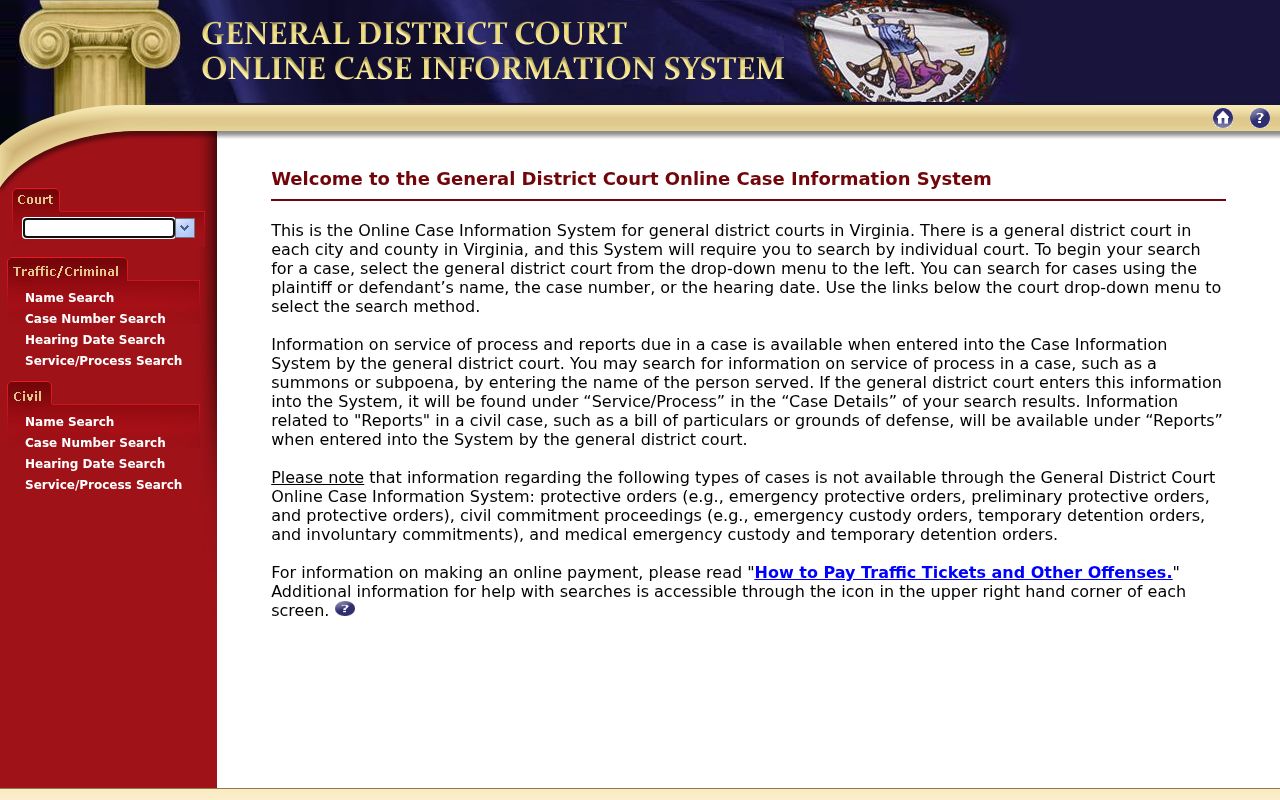
The workflow stays local. Select Fairfax General District Court first, and preserve the case identifier. Then use the clerk for Circuit access. That Circuit route matters most. It applies when a Bailey's Crossroads question touches an estate, will, trust, divorce, property deed, adoption, or another civil file. For any Bailey's Crossroads result, request the case number and document type together. The clerk remains the source for filings, final orders, and certified copies.
Separate Bailey's Crossroads Name Matches
A Bailey's Crossroads resident lookup often starts with a name that belongs to several people. Court parties, parcel owners, and historic directory entries share surnames all the time. That is why a careful search compares more than spelling. Middle initials help. So do unit numbers and dates. Spouse or parent relationships help when lawfully visible. Parcel PINs and the provenance of each source matter too. Partial matches should never be merged into one confident person. The 3400 Washington Drive iCare entry shows the trap. It is a commercial parcel owned by an LLC with a McLean mailing address. Neither the owner nor the mailing address tells you who lives there.
Cite rather than biographize. A safe Bailey's Crossroads output notes the office. It also notes the exact URL or call number, the search date, the record type, the range, and the single fact shown. A parcel record establishes parcel context only. A voter result supports an authorized registration or precinct question. A dated directory entry supports a historical address association. Label each finding on its own before comparing any of them.
Does the question shift from one person to everyone tied to an address? The Bailey's Crossroads street directory carries that separate address-by-address trail.
Bailey's Crossroads Voter Lookup Limits
The Virginia Citizen Portal is built for self-service and authorized use. Its status form asks for first and last name, locality, an optional date of birth, and the last four SSN digits. It also requires a certification that the searcher is the voter or expressly authorized. The portal serves voter services and polling-place information. It is not a tool for casual third-party name harvesting. A result can answer an election-record question. It cannot establish current occupancy or household composition.
Historical or lawful list questions go through Fairfax Elections and the Virginia Department of Elections. Each has its own route. The requestor must identify a lawful category and purpose, and list products carry use certification. Fairfax Elections is the local custodian. It sits at 12000 Government Center Parkway, Suite 323. It is reachable at 703-222-0776 and voting@fairfaxcounty.gov. For any Bailey's Crossroads voter question, match the election date and current map. Do not trust a mailing label to assign a precinct.
Note: Never copy birth dates, SSN fragments, voter IDs, or voter details into a shareable research note.
Bailey's Crossroads Vital Record Checks
Birth, death, and marriage certificates for Bailey's Crossroads sit with the Virginia Department of Health Division of Vital Records. Divorce certificates sit there too. Public access follows a fixed clock. Birth records open after 100 years. Death, marriage, and divorce records open after 25 years under Va. Code §32.1-271. Before those thresholds, certificates stay restricted to eligible people and relationship categories. Knowing a name or a Bailey's Crossroads address creates no eligibility. VDH accepts online, mail, and in-person requests, and the Richmond lobby offers another access route.
The VDH application instructions walk through the form itself. It collects requester and relationship information, record details, delivery details, certification, and identification. Current fees and processing steps live in VDH's own materials, so confirm both before applying.
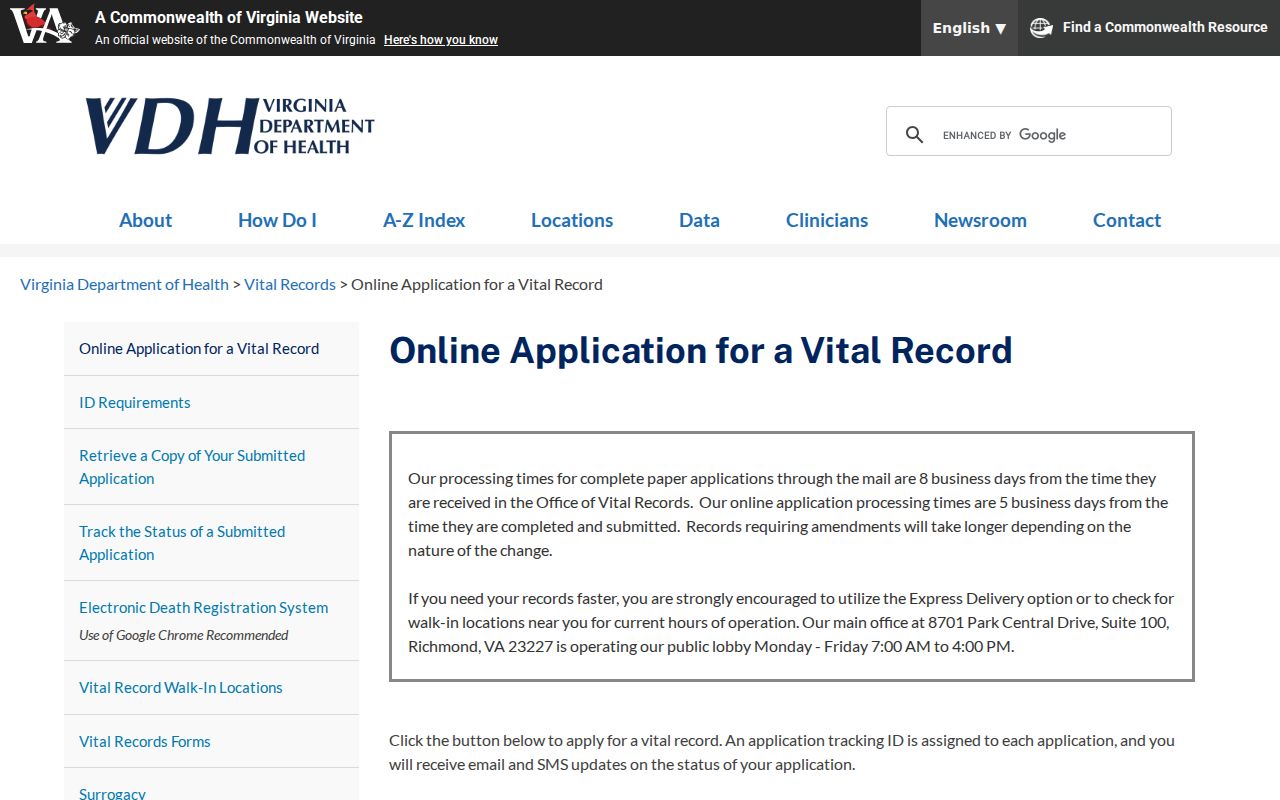
A public-age certificate can corroborate a family event in a Bailey's Crossroads genealogy search. It is not an address history, though. Pair it with a dated deed, a tax map, a directory entry, a census record, an obituary, or an archive source.
Bailey's Crossroads Resident Lookup Requests
When a Bailey's Crossroads record is not posted online, ask the custodian who holds it. The Virginia Freedom of Information Act lets a request be written, emailed, or phoned in. That holds when the custodian accepts that method. Describe an existing record with reasonable specificity. Name your preferred delivery format. The agency may provide the records, cite a denial, report that none exist, or seek clarification. It can also estimate time and cost within five work days. A timely extension to seven work days is allowed.
VFOIA does not make Fairfax County build a name-and-address database from separate systems. Court files, restricted vital certificates, election-security material, and protected-address information each carry their own limits. Historical Bailey's Crossroads work should run through the Historic Records Center and Library of Virginia microfilm. The Virginia Room and archive reference channels also serve this purpose. An online gap never proves a record did not exist.
Note: Give a date range, record title, address or case number, and copy type. That helps the custodian locate an existing record.
Bailey's Crossroads Resident Lookup Safeguards
Some Bailey's Crossroads details are kept from public view by design. iCare can withhold owner names from the web. Voter self-lookup demands certification. Vital certificates carry age and relationship rules. Juvenile, sealed, victim, and protected-address information can be restricted. Virginia's Address Confidentiality Program gives eligible survivors a substitute address and mail forwarding. Its physical-address protections must never be defeated. Do not piece together GIS, tax mailing, voter, or directory clues.
A wrong public display, or one exposing a protected detail, should go to the agency controlling the original record. Virginia consumer privacy rules do not erase a recorded deed, tax map, court file, or archive entry. The correction route depends on the record type. ACP questions belong with the Office of the Attorney General program.