
Finding Bailey's Crossroads Residents
Bailey's Crossroads has no town clerk or standalone municipal records office. Fairfax County is the local route, and each record answers a different question. A parcel file can establish the assessed property and recorded owner. A deed can establish a transfer. A dated directory can place a name at an address in a particular year. None of those records, standing alone, establishes every person who lives at an address today.
Start with the most stable detail you have. An exact address works best for property research; a year and surname work well in a library directory. For a person with a common name, retain the source, date, jurisdiction, and role shown by each hit. The useful outcome is a short, dated record trail, not a blended profile made from partial matches.
- Use the Fairfax parcel and address tools to confirm the site, unit, ZIP, jurisdiction, and parcel identifier.
- Check iCare and the recorded land file for the owner or party role, keeping the tax mailing address separate from the property address.
- For a dated household question, search the Virginia Room, Historic Records Center, or Library of Virginia by directory year and place name.
- Use the Virginia voter portal only when the voter has authorized the search, and treat a result as election information rather than occupancy proof.
- Request a defined existing record from the right Fairfax custodian when an online index does not provide it.
Note: A record that names an owner, voter, or case party may not identify a current Bailey's Crossroads resident.
Bailey's Crossroads Records Offices
The Fairfax Circuit Court clerk, Department of Tax Administration, and Office of Elections hold the main local records used in a residents directory search. Bailey's Crossroads is an unincorporated Fairfax County community, so a request sent to a supposed town office will not reach the proper custodian. Confirm the parcel jurisdiction first, especially where a Falls Church mailing address appears.
Fairfax Circuit Land Records
4110 Chain Bridge Road, Suite 317
Fairfax, VA 22030
703-691-7320, option 3 then 3
Fairfax Tax Administration
County property-data authority
Fairfax County, Virginia
Use the county property contact route
Fairfax Office of Elections
12000 Government Center Parkway, Suite 323
Fairfax, VA 22035
703-222-0776
Land-record research offers a subscription CPAN route online and free public terminals in the clerk's research room. The Historic Records Center, Virginia Room, and Library of Virginia add historical access when the modern system ends. For a narrowly described county-held record that is not posted, Virginia Freedom of Information Act procedures can be used with the agency holding it.
Bailey's Crossroads iCare Parcel Search
Fairfax County's iCare is the practical first stop when an address is known. The Department of Tax Administration, not the GIS display, is the authority for property data. The profile can show a parcel identifier, property location, tax year, assessment, zoning, subdivision, planning area, sales or deed references, and an owner or mailing address when displayed. The county says its web assessment data is updated twice weekly.
The iCare address-search view is the source captured for this Bailey's Crossroads residents directory.
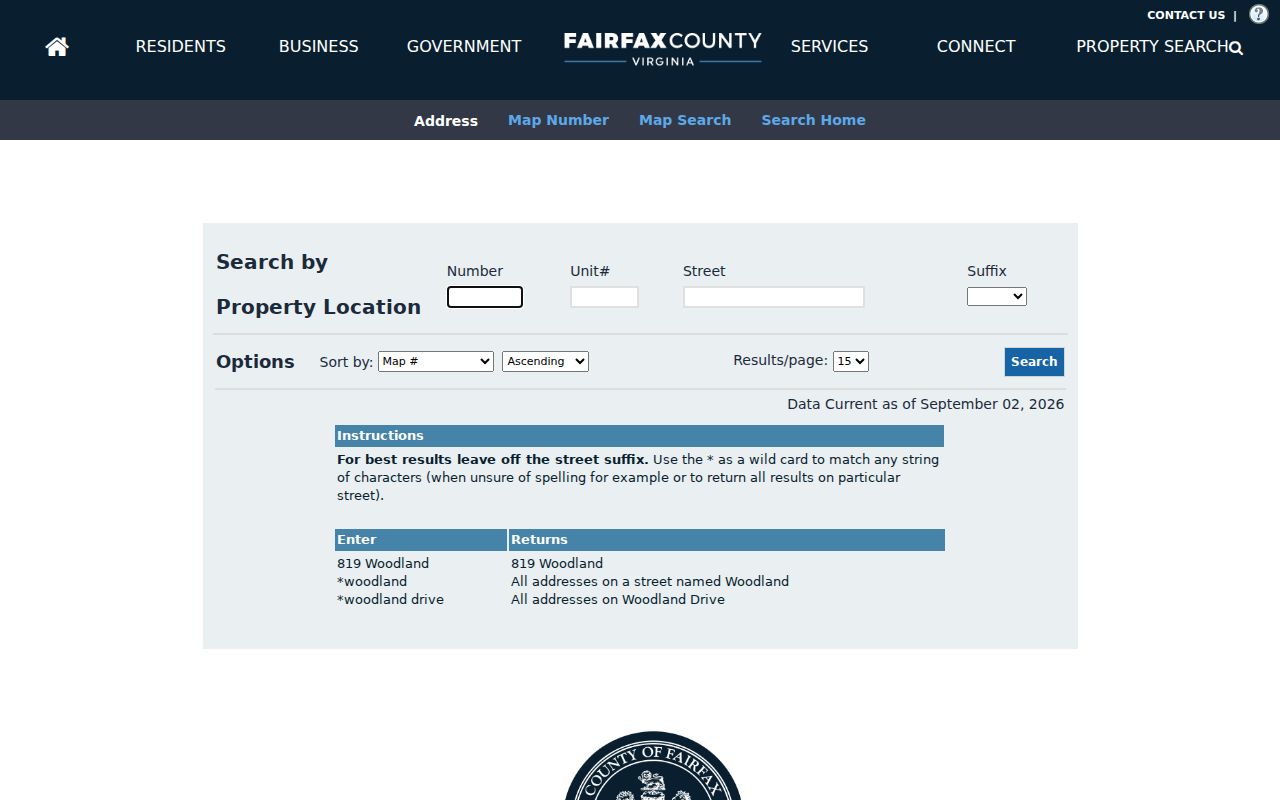
The image shows the county entry point for an address-led search, which is more useful than treating a name alone as proof of a local household.
| iCare search key | Best use | Read with care |
|---|---|---|
| Bailey's Crossroads street address | Find a current Bailey's Crossroads parcel profile | Check the unit and jurisdiction |
| Bailey's Crossroads tax-map reference | Resolve a known Bailey's Crossroads parcel | Keep the PIN with the result |
| Bailey's Crossroads map | Compare nearby Bailey's Crossroads parcel geography | Boundaries are not recorded easements |
| Deed reference | Move to the Bailey's Crossroads recorded land trail | Use the clerk for the actual instrument |
Bailey's Crossroads Voter Lookup Limits
The Virginia Citizen Portal is a self-service and authorized-use tool, not a public name-harvesting list. Its status form asks for first and last name, locality, optional date of birth and last four Social Security digits, plus a certification that the user is the voter or is authorized. Fairfax Elections is the local office for precinct questions, voter services, and permitted list requests.
The Virginia voter status lookup illustrates the certification step required for this type of resident record.
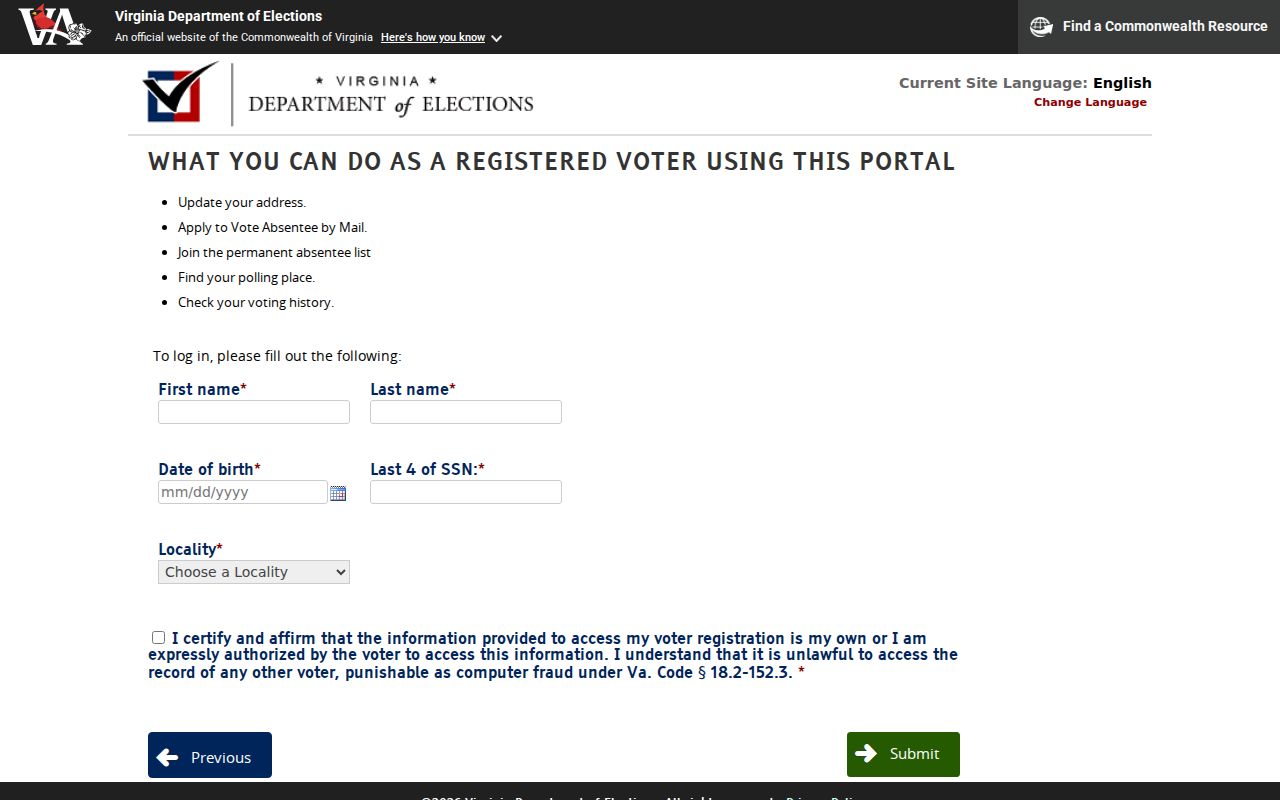
A voter result can support a registration or precinct question. It does not establish present occupancy or identify every person at an address.
Authorized voter-list products have purpose and handling conditions. Fairfax's precinct geography also changes over time, so a ZIP or mailing city should never be substituted for a current precinct check. For history, the Virginia Room and Library of Virginia provide electoral context without functioning as current voter-status authorities.
Bailey's Crossroads Address Roles
A parcel owner, a tax-mail recipient, a deed grantee, a registered voter, a directory entry, and an occupant are different roles. That distinction matters in Bailey's Crossroads because records can carry a Falls Church mailing city while the property remains in Fairfax County. A commercial parcel may also show a company owner and an out-of-area mailing address, neither of which identifies a resident.
- Parcel
- A Bailey's Crossroads property unit identified by a county PIN or tax-map reference.
- Roll
- A Bailey's Crossroads list maintained for a specific official purpose, such as property assessment or voter registration.
- Index
- A Bailey's Crossroads finding tool that points to a record; it is not necessarily the document image itself.
- Criss-cross directory
- A Bailey's Crossroads reverse directory organized by address instead of by surname.
Use the Master Address Repository for the site address and status, iCare for assessment context, and the clerk's land records for legal ownership. The fuller address chain belongs on the Bailey's Crossroads street directory page.
Current Bailey's Crossroads Resident Rolls
There is no single current residents directory for Bailey's Crossroads. The usable official sources are purpose-built rolls. Start with a parcel if the question is about ownership, use a court index for a named case party, and use voter information only through the program's authorization rules. Community associations can identify the name of a neighborhood organization, but their private membership information is not a public roster.
| Bailey's Crossroads source | Role it may document | Custodian | Access route |
|---|---|---|---|
| Bailey's Crossroads iCare property profile | Bailey's Crossroads assessed parcel and recorded owner when shown | Fairfax Tax Administration | Free address, tax-map, or map search |
| Bailey's Crossroads voter services | Authorized Bailey's Crossroads voter status or precinct information | Virginia Elections and Fairfax Elections | Certified self lookup or authorized product |
| Bailey's Crossroads land-record index | Bailey's Crossroads parties to recorded deeds, liens, and instruments | Fairfax Circuit Court | CPAN subscription or public terminal |
| Bailey's Crossroads MAR and Jade | Bailey's Crossroads address, parcel geography, and map context | Fairfax GIS | County online viewers and counter support |
| Civic-association references | Bailey's Crossroads neighborhood or organization name | Mason District and civic groups | County association list and open meetings |
Fairfax Federation and the county association list can help identify Bailey Place HOA, Baileys HOA, or the Bailey's Crossroads Revitalization Corp as a local context clue. They do not substitute for a land, voter, or directory record. When the goal is to separate one similarly named person from another, compare independent records with compatible dates rather than relying on one listing.
Bailey's Crossroads Court Record Route
A court party name can be a useful lead, but it does not confirm that someone resides in Bailey's Crossroads. Virginia's General District Court interface requires an individual court selection and offers party name, case number, and hearing-date searches. Fairfax General District Court cases are part of that route. Fairfax Circuit Court does not participate in the statewide circuit search, so an empty statewide circuit result is not a negative finding.
The Fairfax land-record research hub is the captured source for the local clerk and public-access path.
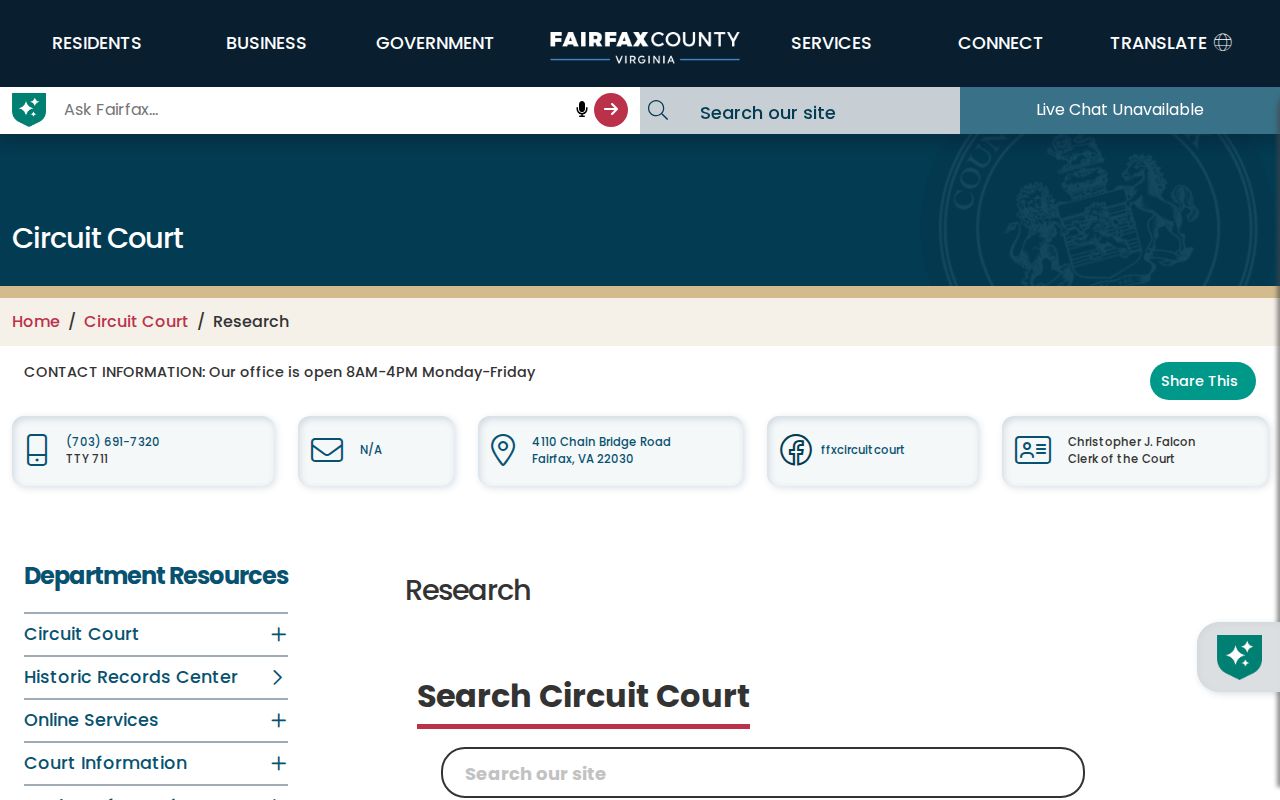
The county source points researchers toward the local record custodian, which matters when a statewide screen has limited Fairfax Circuit coverage.
For a defined local case or copy, contact the clerk or use the courthouse counter and give the case number, document type, party name, and date. The Virginia Room's CPAN station and historical databases can provide context, while the Historic Records Center and Library of Virginia support older material. Do not ask an office to compile an unrestricted personal history from separate systems.
Note: Preserve the court, case number, filing date, and source date before treating a party-name hit as meaningful.
Bailey's Crossroads Vital Record Access
The Virginia Department of Health is the state custodian for birth, death, marriage, and divorce records. Its published coverage includes births and deaths from 1853 to 1896 and from June 1912 forward, marriages from 1853, and divorces from 1918. Birth records become public after 100 years; death, marriage, and divorce records become public after 25 years under Va. Code §32.1-271. Newer certificates have relationship and identification rules.
Use the VDH application instructions for the current form and ordering route. VDH lists online, mail, and in-person channels. For family-history questions outside the available or eligible certificate route, use LVA microfilm, the Virginia Room, cemetery surveys, obituaries, deeds, and dated directories. A vital record can corroborate an event or relationship, but it is not an address history by itself.
Bailey's Crossroads Address Protection
Public records are fragmented by custodian and purpose. Some information remains restricted even when another record is public, including protected addresses, juvenile details, sealed matters, victim information, and personal identifiers. Virginia's Address Confidentiality Program gives qualifying survivors a substitute address and mail-forwarding service. Its rules are a safety boundary, not a challenge to solve by combining parcel, voter, and directory clues.
The Virginia Address Confidentiality Program explains the protected-address route.
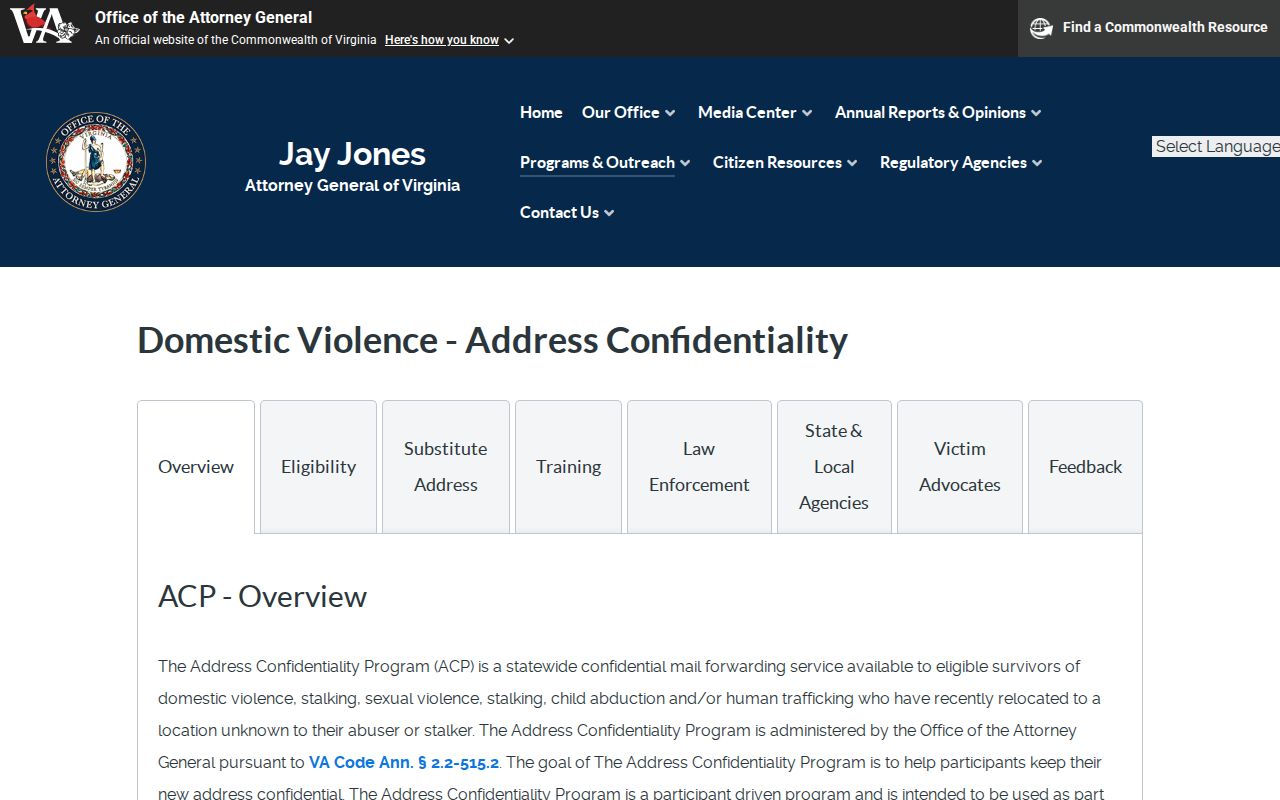
The program source reinforces why a search result must not be used to reconstruct a confidential location or publish a personal dossier.
Lawful use. Bailey's Crossroads records support lawful personal, family-history, civic, and property research. Do not use a name or address trail to stalk, harass, threaten, or harm anyone.
Virginia's Consumer Data Protection Act governs qualifying business data practices, with statutory thresholds and exceptions. It is not a universal erasure method for a county deed, court file, or archive. Ask the official custodian about a correction, redaction, or protected-handling process for its own record.
Historical Bailey's Crossroads Directories
Older Bailey's Crossroads household research usually sits in broader Fairfax County, Falls Church, Alexandria, Washington-suburban, or telephone-directory collections. The Falls Church History Room lists Collins Fairfax County Directory for 1906 and Haines Directory Northern Virginia Suburban for 1980 through 2020. Research also found an 1887-88 Chataigne Fairfax County lead and a 1942 Alexandria-Arlington-Fairfax telephone-directory reference. Those are documented leads, not a continuous run.
The Fairfax County Public Library Virginia Room holds local-history books, city and telephone directories, maps, newspapers, yearbooks, and a microform reader. Record the publisher, year, page, exact spelling, and street form. The detailed collection-by-collection approach is on the Bailey's Crossroads city directory page.
Bailey's Crossroads Archive Gaps
Fairfax County formed in 1742, but the Library of Virginia warns that original deeds, wills, and loose papers were destroyed during the Civil War. Many deed books from 1763 through 1819 and prewar minute books are missing. A blank result in an early owner trail can therefore be an archival gap, not proof that a household or transfer never existed.
The Fairfax County cemetery-survey program is one local-history route that can add a burial or preservation lead to a dated record trail.
The county survey resource belongs beside archives and library collections, not in a claim that a cemetery record alone identifies a modern resident.
HRC holds early court material, the 1760 property-owner booklet and map, an 1860 tax map and key, reconstructed 1890 census material, yearbooks, vertical files, and cemetery material. The Library of Virginia adds surviving Fairfax microfilm. Ask for a precise collection, year, volume, or tax-map number, and keep a source log that notes missing series.
Bailey's Crossroads Record Updates
Fairfax's record landscape changes by system. iCare is refreshed twice a week, while Digital Map Viewer provides annual property-map books back to 1960 and historical imagery reaches back to 1937. A current assessment record and an old map tile are useful for different questions. The county's 2025 preservation grant for Atlas 1879 and tax books from 1892, 1900, and 1910 may improve historical access, but it does not establish that every item is already searchable online.
The Virginia Freedom of Information Act procedure is the appropriate fallback for a reasonably specific existing county record that is not posted.
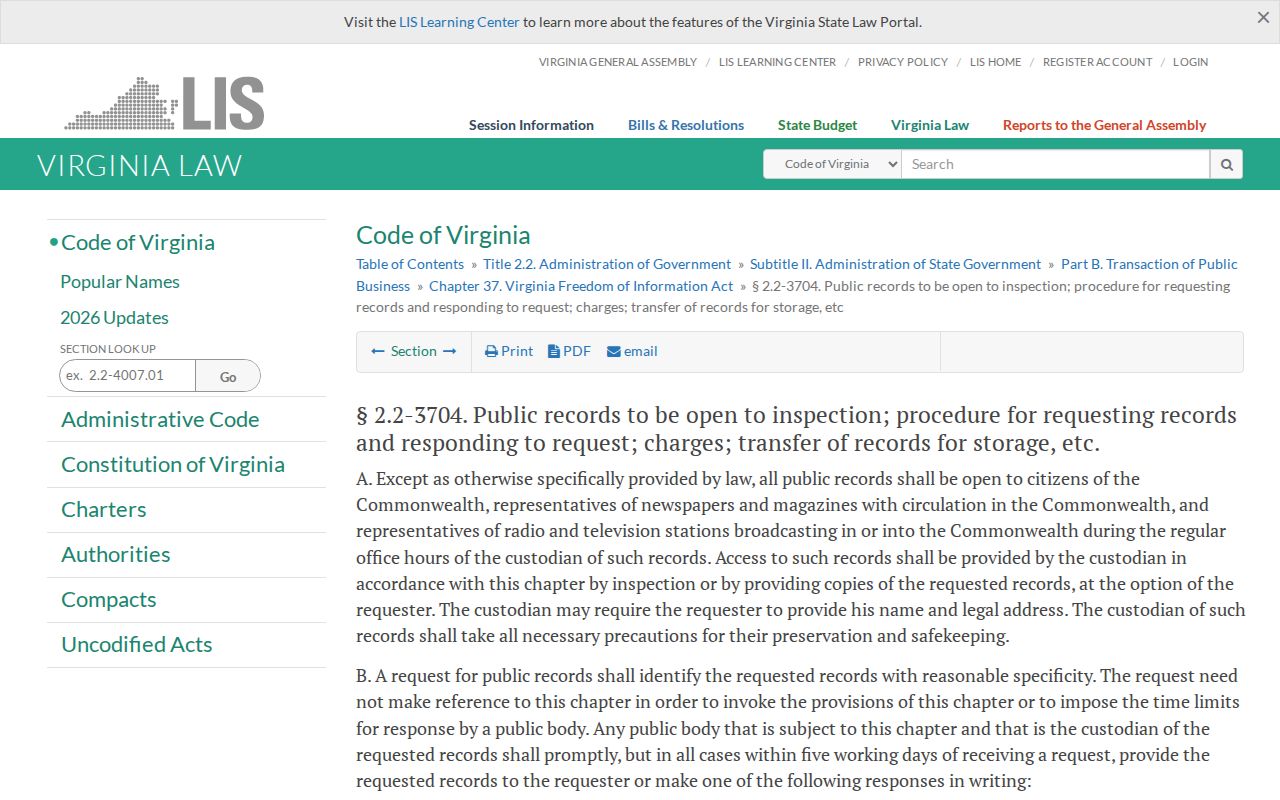
The statute source supports a defined request to the office that holds the record, not a request for a new all-in-one resident list.
Under Va. Code §2.2-3704, a custodian can provide records, cite a denial, say no record exists, seek clarification, or estimate time and cost within five working days. A seven-work-day extension may be used, and a deposit of up to $200 can be requested for a likely high-cost response. Direct the request to the agency that actually has the record.
Online access is only one route. Fairfax land records also have public terminals, and a known instrument or deed-book reference can support a clerk copy request. The Historic Records Center and Library of Virginia fill historical gaps; the Virginia Room supplies directories, microform, yearbooks, newspapers, and a CPAN station. A phone call can confirm which office has a defined file before a visit or request. Mail, email, or a VFOIA request should name the record, date range, address or parcel key, and preferred delivery format.
Current planning files are another reason to date every parcel result. Fairfax's SSPA-2025-I-2B amendment was authorized in June 2025 for tax-map parcels 62-3 ((2)) A/B, under PLUS number PA-2025-00014. It is a planning record, not evidence about a named resident or a future household. The county planning record is useful when a research log needs to distinguish parcel planning from ownership, occupancy, or mailing information.